Vibe Coding: Breakthrough or Just Another Overhyped Trend?
Lately, it feels like you can’t escape the conversation around Vibe Coding. Whether it’s a ping from a curious client, a strategy shift from management, or the constant chatter in dev communities, the pressure to adapt to this new paradigm is coming from every direction. As a developer, I found myself asking a simple but necessary question: How far have we actually come? Is "vibe coding" a legitimate evolution of our craft, or are we just getting lost in the noise?
Over the last month, I decided to stop theorizing and start experimenting. In this blog, I’m breaking down my thoughts, my skepticism, and the personal journeys I’ve taken while putting the "vibe" to the test in real-world scenarios.

Maik Eulitz - April 7th, 2026
From Idea to Code: Understanding Vibe Coding
While manual coding is a marathon of line-by-line precision, vibe coding is a conversation. It’s the difference between drawing a map and just telling the car where you want to go; you focus on the destination and the goals, while the technical path unfolds through a collaborative, interactive process.
This can happen at very different scales. Sometimes it is just a small function, a quick fix, or a single component created from a short instruction. In other situations, it can involve longer discussions about requirements, architecture, and design before building larger parts of an application together with an AI assistant or coding agent.
What defines vibe coding is the flow: describe, review, adjust, and continue until the result matches the intention.
Unleash Potential: Key Benefits of Vibe Coding
The real magic of vibe coding emerges when you see how it reshapes your entire development workflow. Imagine a world where boilerplate disappears, where new developers understand your architecture in hours instead of weeks, where documentation stays up to date without extra effort, and where quality and speed aren't competing forces. That's not fantasy—it's what happens when you let AI collaborate with your team, understand your codebase, and help turn ideas into working software.
Here are the concrete benefits that make this possible:
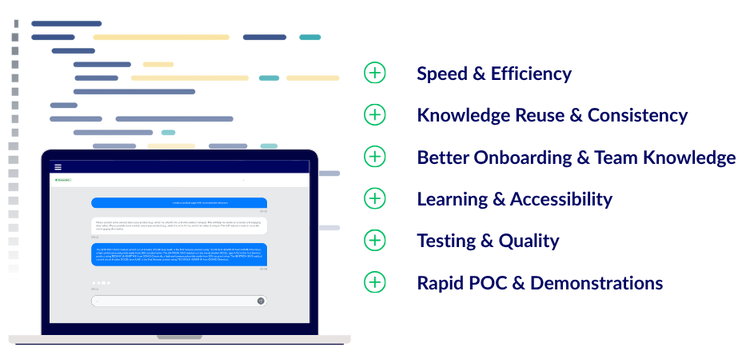
Speed & Efficiency
One of the biggest advantages of vibe coding is speed. Repetitive tasks and boilerplate can be generated quickly, so developers can focus more on solving the actual problem than on writing every line by hand. This also shortens iteration cycles, making it easier to explore, test, and refine different approaches in less time.
You can explore multiple approaches quickly without the friction of writing everything from scratch. You can also rapidly generate proofs of concept to demonstrate ideas in working form to clients and colleagues, turning abstract concepts into tangible prototypes in hours instead of days.
Knowledge Reuse & Consistency
In an ideal world the AI can maintain full context of your repository, coding conventions, naming patterns, and existing structures. This means new code can align seamlessly with what's already there. Plugins, libraries, and frameworks you've already integrated get reused intelligently, avoiding reinvention. MCP servers create a central knowledge base that captures your project's working patterns, tools, and established standards, ensuring consistency across your team and accelerating onboarding by codifying best practices.
Better Onboarding & Team Knowledge
New team members grasp the codebase faster through conversational walkthroughs. The AI can explain architectural decisions and processes on-the-fly. Knowledge transfer happens naturally without lengthy documentation sessions. You can also quickly generate comprehensive documentation with diagrams and graphics that visualize how your system works, making onboarding even smoother.
Learning & Accessibility
In the past, diving into a complex repository meant weeks of dense onboarding sessions and hand-holding by senior devs. Vibe coding changes that dynamic. Because agents can instantly parse and explain logic patterns or system mechanics, the codebase becomes self-documenting in real-time. This allows newer contributors to navigate the architecture and participate in bugfixing almost immediately—not by replacing the expert, but by allowing the expert to focus on high-level guidance instead of repetitive walkthroughs.
Testing & Quality
Writing unit tests becomes faster and more thorough. You can quickly validate features and functions as they're built, catching issues early in the process.
The Reality Check: Real Risks of Vibe Coding
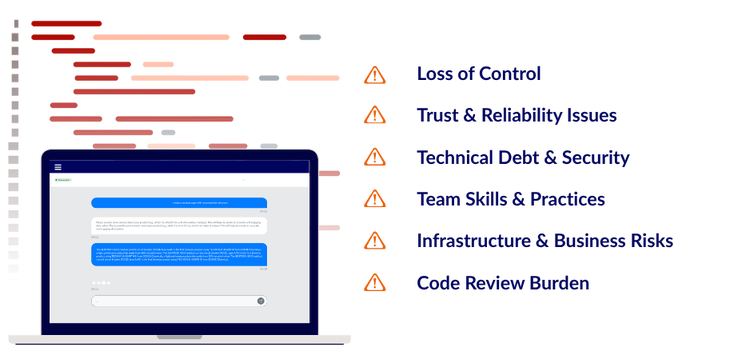
The potential is real, but so are the pitfalls. While vibe coding offers tremendous advantages, it's important to approach it with eyes wide open. Like any powerful development practice, especially one that involves AI collaboration, it introduces new challenges and considerations. Before embracing vibe coding fully, it's worth understanding the risks and limitations that come with letting AI shape your codebase. Knowing these challenges helps you mitigate them and use the approach more effectively and responsibly.
Control & Quality
One of the biggest concerns with vibe coding is the loss of control over your codebase. AI can over-create files and approaches, generating more than you actually need. Code review burden increases dramatically—you're now validating not just logic, but verifying that generated code follows your standards and patterns. Quality becomes inconsistent; results vary wildly depending on how clearly you frame your requests and how well the AI understands your context. In that sense, quality depends not only on the model, but on the structure and governance surrounding its use.
Trust & Reliability
Here's the hard truth: you can't fully trust AI-generated code, even with clear guidance or advanced tools like MCP. The AI might ignore your instructions, sometimes subtly, sometimes obviously. It's not truly intelligent, but instead relies on pattern matching and mathematical probability. This means hallucinations can happen regularly. The AI confidently suggests libraries that don't exist, APIs that aren't real, or methods that won't work. You need to verify everything. Even worse, when the AI can't find the right solution, it often falls back on mock data, placeholder implementations, or workarounds that make code look functional in isolation but fail in production. What looks like a quick solution during development can easily turn into a problem once the code needs to perform reliably in real-world.
Technical Debt & Security
Speed comes with a cost. AI-generated code can introduce security vulnerabilities, follow insecure patterns, or hide flaws you won't catch immediately. Quick code generation often creates technical debt that compounds over time. Dependency bloat is another risk, as AI may suggest packages or libraries that are not strictly necessary, adding complexity to the tech stack. This can make systems harder to maintain and evolve over time. Debugging can also become more challenging, since understanding the behavior of AI-generated code often requires additional effort and context.
In larger systems, these issues are further amplified by context window limitations because AI cannot fully consider the entire codebase at once.
Team Skills & Practices
There's a subtle but real risk of over-reliance on AI. Developers can lose the habit of thinking critically about code, lose direct issue recognition skills, and gradually lose core coding abilities. When junior developers always lean on AI, they miss the learning that comes from struggling through problems themselves.
Infrastructure & Business Risks
Finally, consider vendor lock-in. You become dependent on a specific AI tool; switching later is expensive and disruptive. Privacy is another concern. Your code gets sent to external AI services, raising questions about intellectual property exposure and data security.
Finding Balance: A Developer's Perspective
My Journey with Vibe Coding
I've experimented extensively with vibe coding across multiple projects, and the results have been eye-opening—both in the best and most humbling ways.
The biggest win has been speed. Vibe coding transformed how I approach POCs and client demonstrations. What used to take weeks of UI development now takes days. I can focus on what truly matters: the logic and functionality behind beautifully designed interfaces. The visual polish that once consumed massive amounts of development time now emerges naturally alongside the concepts themselves. This shift has been liberating.
But here's where reality hit hard. I attempted a full POC with zero manual code—just pure vibe coding. It was the most frustrating week of my career as a developer. I found myself trapped in loops of "Eureka, we solved it!" followed by "Wait, that still doesn't work." The AI generated working code, yes, but it came with a mountain of unnecessary files, duplicate functions, and test scaffolding that had no connection to the actual architecture. I ended up with a functional POC, but I couldn't fully trust it. The loss of control was real, and it showed me the limits of hands-off development.
The breakthrough came when I found the sweet spot: using vibe coding strategically. For POCs and demonstrations? Invaluable. For complex architectures where I need full understanding? I need to stay involved.
I also discovered an unexpected benefit. While building AWS infrastructure with AI guidance, I received step-by-step documentation explaining the why behind each decision. This transformed how I approached unfamiliar tech stacks. The AI helped me understand and navigate systems I'd never encountered before, accelerating my learning curve significantly. However, it's important to note that this understanding comes with a caveat: the AI often misses connections to how architecture best practices normally fit within my specific project context. For POCs with short life cycles, this works wonderfully and helps me gain knowledge quickly. But when moving toward production, I absolutely need to step in and review these decisions carefully, ensuring they align with my broader architectural standards and long-term maintainability.
The Responsibility That Comes With Power
Vibe coding is powerful. As Uncle Ben once told Peter Parker, "with great power comes great responsibility." We need to wield it wisely.
Use vibe coding where it excels: rapid prototyping, POC development, quick demonstrations to clients and stakeholders, and fast iteration on ideas that don't require production-grade certainty. It's a tool for speed and exploration.
But be cautious about production solutions. Even deeply reviewed AI-generated code isn't the same as code you have fully designed, understood, architected, and built with your own hands. Something gets lost in the process—the sense of ownership, the deep understanding, the instinctive knowledge of how every piece fits together.
The path forward is clear: find the right scenarios for vibe coding. Use it to accelerate where speed matters. Keep humans in control where trust and quality are non-negotiable. The goal isn't to let AI write all your code. It's to be smarter about where you collaborate with AI and where you stay hands-on.
Hungry for more AI insights?
If you enjoyed this deep dive into Vibe Coding, check out our Content Hub for technical whitepapers and case stories on how we are implementing Generative AI for industry leaders.